
Gifts · Family · Ideas
Diwali gift ideas for family: 10 stories to turn into a comic
Diwali gift ideas for family that aren't another box of sweets: 10 festival memories to turn into a personalised comic, and how to collect them before the day.
By the Comic World Studio · · 5 min read
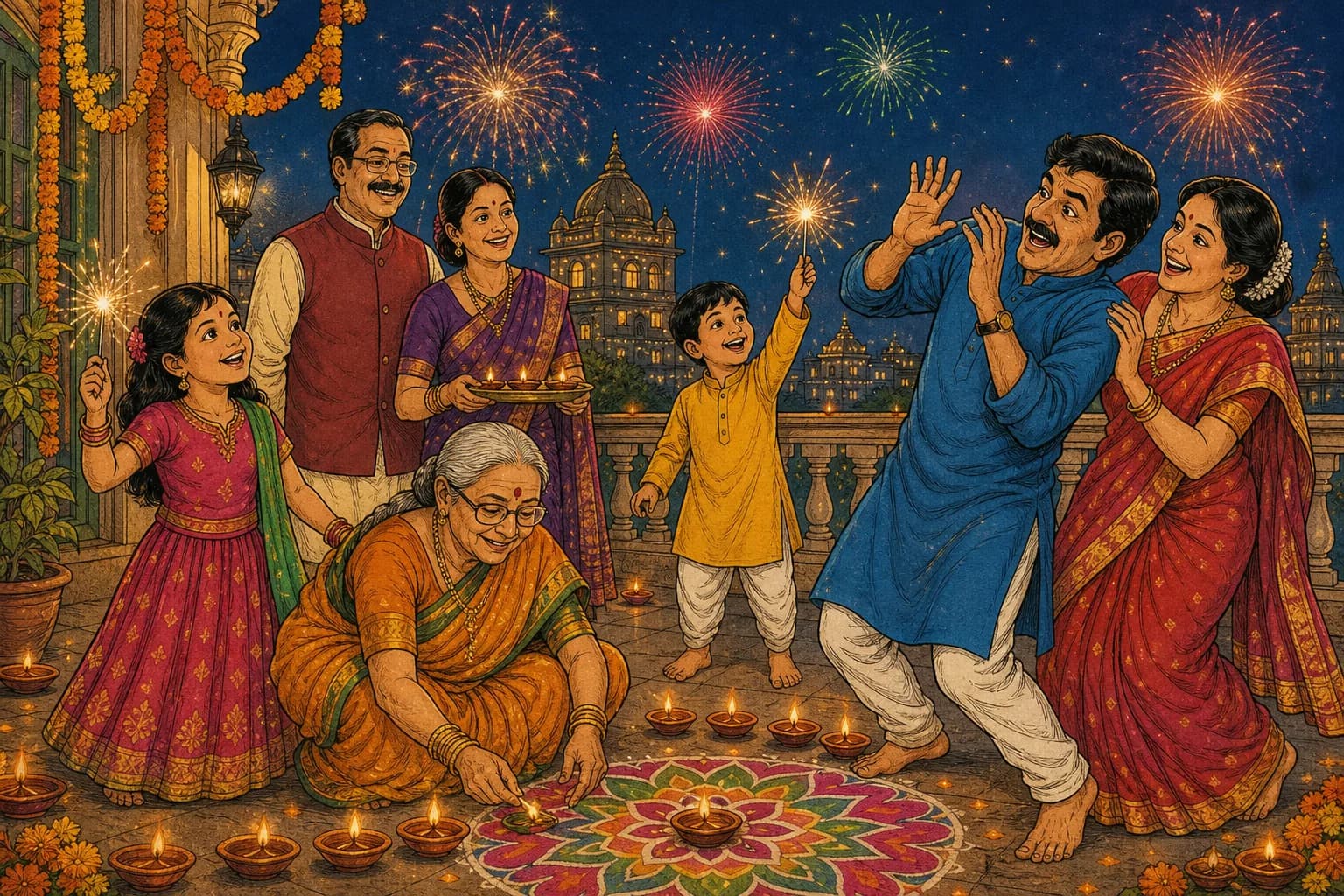
Every family has a Diwali story that gets retold every year. The year the diyas set the curtain on fire. The year Dadi won at cards and refused to give the money back. The year the whole building lost power during the puja and the neighbours turned up with candles.
That story is the best Diwali gift idea for family you'll find, because nobody else can buy it. Turn it into a comic and it becomes something people pass around the living room, argue over ("that's not how it happened") and keep.
Here are 10 festival stories that make good comics, how to collect them before the day, and how to pick a style the older generation will enjoy.
Why a story beats another box of sweets
Mithai gets eaten, a decorative lamp gets put in a cupboard. A story told well gets re-read. And Diwali is already about stories: Rama's return, the lamps, the cleaning, the cards, the cousins arriving from three cities.
A comic suits it because it carries faces and voices. Your uncle's exaggerated storytelling, your mother's one-line replies, the exact chaos of the rangoli: all of it fits in a panel. If you want the wider picture first, our guide to personalised comic book gifts covers every occasion.
10 Diwali stories worth turning into a comic
- The great cleaning. Every family has a cleaning legend: the cupboard nobody had opened in ten years, the old photo found behind it, the argument over what stays. Cleaning day is full of small discoveries, and discoveries make good pages.
- The year of the disaster. The firecracker that went the wrong way, the diya that tipped, the sweet that didn't set. Funny now, mortifying then. Pick one that everyone laughs about today.
- How Diwali looked when your parents were kids. Ask for the sweets made at home, the new clothes once a year, the neighbourhood visits. It shows two Diwalis side by side, then and now.
- The card game. Teen patti night has plot, rivalry and a villain. Someone always cheats. Someone always sulks.
- The first Diwali after marriage. A new bahu or damad meeting the whole family, learning the unwritten rules, getting handed a task nobody explained.
- The Diwali you spent far from home. Hostel, a new city, a flat with one diya and a video call. A quiet story, and often the most moving.
- The cousins' reunion. Fifteen people, one house, one bathroom. A group comic where everyone gets at least a panel.
- The recipe. One dish, one person, one secret ingredient they never wrote down. The story of how it was made, and who finally learned it.
- The Diwali that almost didn't happen. A year of loss, illness or a hard season, and how the family lit the lamps anyway. Handle with care: ask the family first and let them decide what is told.
- A family timeline of Diwalis. One page per decade, the same house or the same table, the people changing around it. Comics are good at showing the same person at different ages.
How to collect the story without spoiling the surprise
You don't need a script. You need a few good details, collected quietly.
- Ask one person, then check with a second. Call the family storyteller, then ask a sibling "what do you remember about that year?" The differences are the best part.
- Write down exact words. "Beta, the diya is on the curtain" beats "there was a small fire".
- Note who was there and what they wore. Clothes and ages help the drawing a lot.
- Collect three small details. A smell, a sound, an object. The marigold garlands, the crackle from the street, the steel plate of laddoos.
- Find one funny line and one tender moment. Those are your two pages that everyone will remember.
On Comic World you tell the story by voice or by typing, and we ask a few follow-up questions, usually 4 to 7, until we have the people, the order and the feeling. Stories are told in English for now. If the story belongs to an elder, sit with them, tell it back to them and add what they say.
Make the people look like themselves
Likeness matters more than anything: Dadi should look like Dadi. For the main characters you can upload 1 to 4 photos each, or describe the person and let us suggest a look. We check every photo, and you approve each character's design before any page is drawn. If the story spans years, a person can be drawn at different ages. Our guide to photo to comic character explains which photos help most. A clear, well-lit face and a few older pictures go a long way.
Only upload photos of people who are happy for you to use them.
Choose a style your family will enjoy
For Diwali, the obvious pick is Desi Classic: bold outlines and warm print colours, like the illustrated comics many of us grew up reading. It feels like the shelf at a grandparent's house, and it works for festival and family stories.
Other good options:
- Modern Cartoon if the audience is kids or the story is silly.
- Watercolour for the soft, remembering kind of story.
- Pop if the chaos is the point.
Each of the 14 styles tells a story differently, not just draws it differently. The comic art styles guide shows all of them, and the Explore wall has real comics to look at.
Keep it short and keep it yours
A good family comic is not a family encyclopedia. Typical comics are 6 to 10 pages plus a cover, and 12 at most. One Diwali, one event, one clear ending beats a tour of every festival since 1985.
Give it a title the family would say aloud, such as "The Year the Curtains Burned". Before anything is drawn you review a stick-figure storyboard, where you can change every scene, caption and line of dialogue. Nothing is drawn until you approve it. When it is finished you can download it as a PDF or as page images, which is good for screens and home printing.
Common questions
How early should I start?
Diwali is in early November, so start now. Collecting the story is the slow part: calls, memories, photos. Give yourself time to gather it and review the storyboard.
What if the family can't agree on what happened?
Good. Use it. "Dad says it was a rocket, Chacha says it was an anar" is a joke the whole family can enjoy.
Can I make it for more than one person?
Yes. A family-wide story, such as the reunion or the timeline of Diwalis, makes one gift that everyone can read.
What if I'm not sure which story to pick?
Ask yourself which one you'd miss if nobody told it again. That's the comic.
Start with the story
Pick the Diwali memory your family keeps retelling, and tell us your story. We'll do the drawing.